

Mid-stride I pause and come to stillness. It’s not the view of Bear Lake, but the squirrel on the trail next to it that stops me. Paige stops alongside me without question, for she is, in fact, also sharing in the revelation of our new furry friend. I am mesmerized by him and want to stop to truly take him in; Paige turns to her Seek app to learn his name: Tamiasciurus hudsonicus
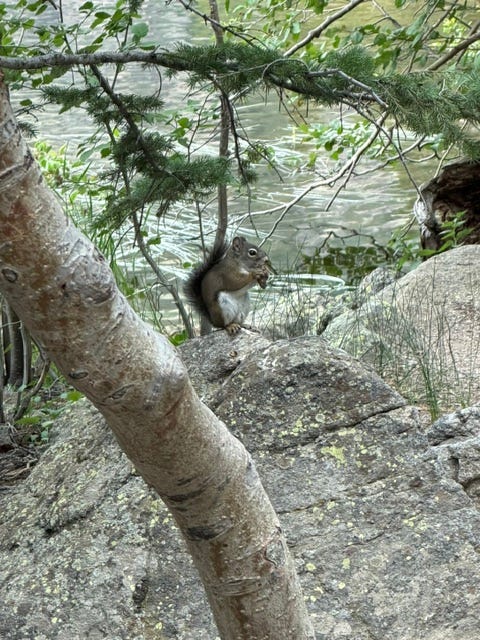
Both of us are looking to more deeply understand and connect with who we’re standing in front of. Not just any squirrel, but this particular squirrel, his species, his features and mannerisms, the specific arrangement of facts that make him this animal and not the idea of an animal. We are crouched, quiet, watching him work a nut in his hands.
He sits on the crown of the rock with his bottom half gone to stone. Nothing below the waist moves…not a haunch, not a foot. Every spark of energy he is has climbed up into his top half. The nut turns, spinning between a blur of his hands. A fleck of shell drops. Another.
Four hikers come up the trail behind us and stop. They think Paige is taking a photograph and they don’t want to ruin the shot, which is a small kindness, and I appreciate the human-to-human courtesy. I wave them on — go ahead, you’re fine. We’re just watching this little guy. And as they pass, they see what we’ve stopped for. They see that it is, in the end, a squirrel. Just a red squirrel.
I see the thought, perhaps confusion, perhaps judgment on the faces of the first three. But it is the fourth that puts the thoughts of the group to words, spoken aloud as she walks by: It’s a squirrel. There are a million more of them on the trail.
It’s spoken not quite cruelly, but with the particular flatness of someone whose day has, in her opinion, just been ever so slightly inconvenienced for what she considers no good reason.
And they walk on.
I didn’t say anything aloud. But something in me answered. There are a million more of them on the trail. But not this one.
Because yes. There are a million more. But not him.
This one will be dead by spring, most likely, and will never be on any trail again, and the fact that there are a million more does not make him replaceable, any more than the existence of eight billion people makes any individual human unremarkable enough to count.
When she spoke the words, all I could think was that we would never try such a statement the other way. We would never stand over a human being and say, It’s a person. There are billions more where that came from. We recoil at such dismissal, and rightfully so. It’s the logic of the worst things people have ever done to each other. And we say it about the living world without a flicker, a hundred times a day, and call it common sense.
I don’t think that woman is a bad person. I think she has a very ordinary illness, and I have it too, and so do you. We have been trained out of attention. We have been taught that the common is the unremarkable, that abundance of a species cancels its worth, while abundance of material things amplifies our value. We’ve come to love dead things while ignoring life, and believe what we’ve been told that a thing you could see a million times is a thing not worth seeing once.
It is the most efficient possible way to live in a world you intend to use and not love.
If nothing is particular, then we don’t ever have to mourn.
But common and unmiraculous are not the same, and somewhere we started treating them like they were.
And I wanted to ask that woman on the trail that told me she knew of a million others just like the one I was connecting with: do you know even one of them? Have you ever, in your life, stopped long enough to know a single one?
Because this one has a name now. I’ve named him Bruce Hudson, (yes, he gets a first and last name. The last being a shared one with his family and the first because he is an individual). I know his coloring now: the gray of him, the white chest, the black-edged tail. I know he is still and racing at once, and that the two never war in him the way they war in us. I know that he holds a nut in his left and works it with his right, so precisely and so fast, each hand at a different job, that I found myself wondering, for the first time in my life, whether a squirrel can be left-handed. I have no idea. But it is the kind of question you only get to ask about a someone. You don't wonder whether an idea is left-handed. And after a few moments of watching his relationship with the world around him as he worked the nut in his hands, I saw him scurry away into the shelter of the trees, which are alive and worth naming, too.
Bruce did not become worth watching because I chose to stop mid-stride or because Paige pulled out her app to find his particular species. He was always this specific, always this improbable, always a someone. He was always.
It was our own schemas (the way we see the world) that determined whether or not to register that. The woman’s schema said just a squirrel, whereas ours, Paige’s and mine, cracked open that self-focused worldly schema that has been handed to us by society, and decided instead to peek inside to see what else could be. That choice, to see and to connect, is what allowed us to see that the thing that keeps us human is the act of living in the plain astonishment that all of this life is here at all and that it is worth noticing even at the smallest level. Maybe especially at the smallest level.
You cannot love a million of anything. Love doesn’t work at that scale; it never has. But you can love one. You can know one. And it turns out that knowing one is the whole thing. I believe that it will be the person who has knelt on a cold trail and actually seen one squirrel who will be closer to saving the world than the person who has walked past a million.
There are a million more on the trail.
Yeah.
But not this one.
I love that you named him Bruce! Beautiful essay as always Jamie.