

Today, Peter Singer wrote an article “KEY OUT”: When a Chimpanzee Asks to Be Free.
It’s a story that deserves to be read, and I’m hopeful it sparks more dialogue and advocacy. I also want to add a piece to the conversation, because I think there is a perspective we’ve been missing.
When chimpanzees are held in zoos with a record of questionable treatment, we debate whether they have a right to liberty. When a chimpanzee asks a man to open his cage, we argue about whether the chimpanzee had a grammar.
Nobody has asked what it’s done to the people.
In 1988, Roger Fouts and Jane Goodall sent a graduate student named Mark Bodamer into a biomedical laboratory in New York to build an enrichment program for two hundred and fifty chimpanzees.
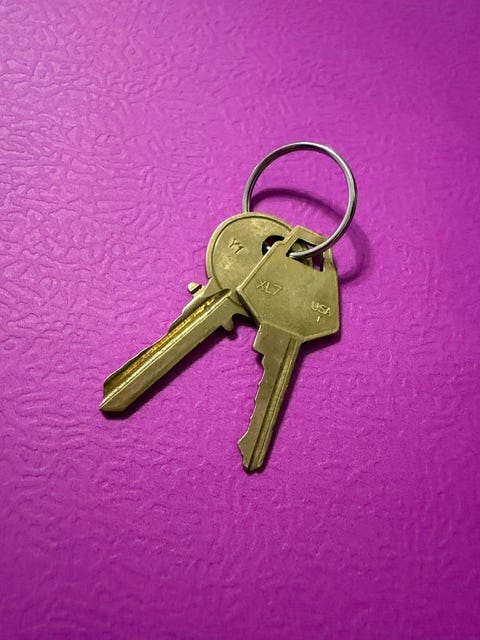
Some of those chimpanzees had been raised in sign language. They had been taught by humans, in homes and research nurseries, and then sold into the lab, where the technicians who fed them and drew their blood did not know a single sign. So they went on signing into a room where nobody could read them. Visitors reported that they asked for food. For drinks. For the keys to their cages.
Bodamer went to see one of them, a chimpanzee named Bruno.
He asked Bruno, in ASL, what his name was.
Bruno did not answer the question. He signed KEY. Then OUT.
Bodamer signed that he didn’t understand, and asked him to sign again.
Bruno signed again.
OUT KEY OUT.
He went to the cage door and crouched there and kept signing. OUT. OUT.
Bodamer signed back three words:
CAN’T. SORRY. CAN’T.
Bruno’s posture deflated, he stopped signing, and retreated to the back of his cage. The cage where he would later die. No key. No out.
Bruno ended there.
His story is surfacing again this month, in Singer’s essay and in a dissent from a Justice of the Michigan Supreme Court.
Here is why it surfaced. Seven chimpanzees are held at a roadside zoo in Wallace, in Michigan’s Upper Peninsula. The Nonhuman Rights Project asked our courts a narrow question about whether a court is obligated to look at whether their confinement is lawful.
On July 17th, the Michigan Supreme Court declined to hear it. Every Michigan court declined to look. The zoo was never even required to respond.
One of the seven has a name we know. Louie arrived in 2010, at six weeks old. Filings say he was used for at least his first two years as a prop in paid photographs, on a fixed leash, handed to children, and that he then spent at least half his life without the company of another chimpanzee.
They are all still there today.
Justice Elizabeth Welch dissented alone, in seven pages, and Bruno is in them.
I’m grateful he’s being remembered. I’m hopeful his story becomes a catalyst.
But this is not only about Bruno.
I want to talk about the man who had to sign back.
Mark Bodamer was not a bystander and he was not a villain. He was sent there by Jane Goodall. He came to make things better. He was one of the few humans who could understand what Bruno was saying, and he understood it perfectly, and the understanding is precisely what made it unbearable.
He had complete moral clarity about what was being asked of him.
He had a relationship with the being asking.
He had built an identity around being a person who helps animals.
And he had no power whatsoever to open the door.
Injury happens exactly there: where moral clarity and relational bond run headlong into the absence of agency.
Moral distress and moral injury are wounds that come from knowing the right thing and being structurally prevented from doing it. From participating in, witnessing, or failing to prevent an act that violates your deepest moral convictions, often while doing exactly the job you were sent to do. I have spent the last several years documenting it in animal care workers, because it turns out that the shelter, the clinic, the sanctuary, and the lab are also places where good people are handed impossible instructions and told this is the work.
Can we slow down for a moment and stand where Bodamer stood? Allow yourself to become him for moment:
The building is loud. Two hundred and fifty chimpanzees, and the vibrating metal hits my ears, reverberating in waves. Somewhere a door is being rattled in a rhythm with no end to it and no purpose.
It’s construction-site noise. I stiffen against it and keep walking, because I came here to build something.
And movement feels easier because I am floating. I have wanted this since I was a child. Everyone knows Jane. Every kid in every country who ever saw a photograph of her crouched in the grass beside them has wanted to be like her. To be with the chimps. And in all the world of those longing for the same dream, somehow she came to know me by name. And she chose me.
I am finally among the chimpanzees, and I am going to make this place better.
I walk through the rows of concrete and cages. He is watching me before I reach him.
I raise my hands. Wanting to know him, and give to him what Jane has given to me. YOUR NAME?
He doesn’t answer it.
His hands move; it’s not a response, not the call-and-answer we train for and publish on. He is starting a conversation of his own.
KEY. One finger crooked, turning in the palm of the other hand, the shape my own hand makes at my front door. Then he pulls one hand out of the grip of the other. OUT.
I have been signing for years. I know exactly what I saw. The floating stops. It collapses back into my body and into the pit of my stomach into a block of concrete, heavier than that of the cage he sits in.
I sign: NOT UNDERSTAND. SIGN AGAIN.
He shifts his weight and squares his body toward me, the way a person does when they want to be certain of being heard. He lifts his hands a few inches, up out of the shadow of the bars, into the light where I can see them clearly.
He is accommodating me. Thinking that I need help to see him.
He signs it again, slowly, cleanly, so there can be no mistake.
OUT KEY OUT.
The concrete in my stomach explodes and becomes shrapnel in every inch of my body.
He moves to the front of the cage and crouches by the door, the way you wait beside a door you expect to open. OUT. OUT. OUT.
My hand is already coming up. I know what I am going to do. I knew before he finished.
My index finger strikes down past the other one. The sign is small and it is violent and it has always been violent; I have simply never noticed.
CAN’T.
My hand closes and circles on my chest. Over the heart. Where I am bleeding out. I have made the sign a thousand times without once thinking about where it lives in the space that gives us life.
SORRY.
And then, because he hasn’t moved, because he is still watching my hands, because he is waiting for the other answer…
CAN’T.
His shoulders drop. Not all at once. I watch hope travel through him and out of him.
He stops signing. He turns and goes to the back of the cage and sits with his back to me.
Everything I am is wounded in that moment.
I came here to make it better…
“Why didn’t he just open the cage?”
In my work, when I raise the toll this takes on the people doing it, a common response from the public is hostility. How could he leave him? Why didn’t he just open the cage? What a monster.
I want to suggest those responses come from the very place we share and need to build on: the value of life, of love, of compassion. But how we manage that pain becomes a barrier. We accuse Bodamer to displace our own responsibility. We insist we would have done differently in order to preserve our own identity.
So stay with me while I explain what I mean when I say he had no power whatsoever to open the door.
The CAN’T is agency collapse.
Our ability to live out our morals largely depends on agency. And when we locate agency solely within the individual, we blame the individual person for not walking to the desk, taking the key, and releasing Bruno.
But Bodamer was operating inside a system.
What happens after he unlocks the cage? Where does he go with Bruno? What does he say to the two hundred and forty-nine other chimpanzees as he walks past them on the way out? If he unlocks all of them, where does he go with two hundred and fifty chimpanzees?
Any answer has to account for the fact that he is fired immediately and has no livelihood. That he is very likely in jail by nightfall. That building security or law enforcement will retrieve the chimpanzees and return every one of them to the cages they came from, and that Bruno’s next enclosure will be the same or worse, and nobody who can read his hands will ever be allowed near him again. There are also those who would condemn Bodamer if he took such an action, because Bruno was there in the first place because someone, somewhere said it was “for the greater good.”
And if instead Bodamer tried to free Bruno the “right” way, the lawful way, the way we tell people to do it? Forty years later someone did exactly that, in my state, for seven chimpanzees in Wallace. It went to the Michigan Supreme Court. The Court declined to look.
We have built a system in which Bruno stays in a cage and Bodamer stays in one too.
Because agency is not only an individual property. Agency is eradicated from, or built into, a society by its systems.
The only way Bruno gets free is if we collectively take our agency back. It was never going to be one man acting alone.
Mark Bodamer died in 2020. He was 62. He carried that exchange for thirty-two years.
So I wonder what those thirty-two years were like. Not only that Bruno anguished in his cage while Bodamer “let him stay there”, but that Bodamer anguished in his own, and we let him stay there too.
We say we would have freed Bruno. I have my doubts.
Because to Bodamer, and to everyone like him still doing this work, what we are actually saying, with our budgets, our statutes, our common law, our silence is:
CAN’T. SORRY. CAN’T.
Bruno’s story is told as an animal welfare story. But in every animal welfare story, there is a person in it, too.
There was a technician at that lab who fed Bruno every day and could not read a word he said. There is someone at the zoo in Wallace who carries food to Louie through the winter, in a building the public hasn’t been allowed to see since 2023. There are veterinary and shelter teams in this state euthanizing healthy animals for space and then driving home. There are researchers, inspectors, foster coordinators, and there is the person reading this who has done something at work they will never fully describe to their family.
The law’s categories do not only fall on the animals. They fall on the humans standing next to the animals, holding all of the moral clarity and none of the authority.
This is what I mean when I say the broken human-animal bond is a single wound with two sides. We did not sever ourselves from the rest of creation and leave ourselves intact. Dissociation has a cost, somebody pays it, and it is usually the person nearest the cage.
We must recognize that animal welfare stories are also occupational health stories, theological stories, legal history stories, and stories about what happens to a human being who is asked to look directly at something and then forbidden to act. Those are not five different stories. Studying them in separate silos is how we’ve managed to miss the shape of the thing for a century.
Where do we go with that despair?
If you read all that and feel devastated, or find yourself asking what do we even do: this part is for you.
If you haven’t started yet but feel the pull: every one of us in advocacy started somewhere. One day, one small action, that grew. You are not too late. You are not too small. You are exactly where you’re needed and needed exactly now.
If you are already in it, carrying the sorrow of your own cant's: remember that Mark Bodamer, sent by Jane Goodall herself, could not open that door either. Your can’t is a failure of the system. Your agency was never meant to be yours alone.
It was meant to be collective the whole time. That is how we get to the other side of this.
In my research and in my own body, I know this: shame does not move people. Graphic suffering does not move people. Both trigger defense, then avoidance. If the goal is a changed life and a changed society, horror is the wrong instrument.
What moves people is moral beauty. Watching someone do a right and costly thing.
So let me tell you the moral beauty here.
Mark Bodamer walked into that laboratory to build an enrichment program for beings he knew were sentient, and he learned their language, and he noticed when one of them asked him for a key that he couldn’t give. And then he spent the rest of his life on it. He taught psychology. He worked at a chimpanzee sanctuary in Zambia that mattered enormously to him. His obituary says he inspired his students to look deeper at the relationship between humans and the world around them.
And in 2020, the last year of his life, he told the story of Bruno, in his own words, for a book.
He could have taken it with him. He handed it over instead.
Six years later a Justice of the Michigan Supreme Court read his account into the permanent record of a case about seven chimpanzees, in a dissent she wrote knowing it would not open a single door on the day she penned it. Her colleagues had already decided. She wrote it anyway.
Peter Singer keeps writing. The Nonhuman Rights Project keeps filing. And almost the same week Michigan declined to look at seven chimpanzees, a court in Buenos Aires recognized two goldfish as sentient beings with legal standing and moved them out of a restaurant window.
The collective is growing. You are invited.
Justice Welch closed her dissent by noting that the Legislature can still act, that our animal welfare laws, including the ones on confining chimpanzees, remain ours to change. That is an opportunity, in our state, with our representatives.
Let’s take our agency back. For Bruno. And all those like him who are still asking for the key.
WILL TOGETHER WILL
Thank you so much for this. I came upon the Bodamer/Bruno story while reading Justice Welch's dissent in the DeYoung case, and a subsequent search found your (truly) brilliant piece. Just one question: Do you know the name of the book in which Mark relayed his experience? Save for posts from you and Peter Singer, there's not much out there.